

St John’s and the Colonial Past
by Dr Mishka Sinha
The Case of the Debating Society
The St John’s College Student Debating Society was established in 1879, and continued to keep records of its debates in the Society’s Minute Books until 1953. From the 1870s, when the Debating Society was founded, the University of Oxford, the city, the College, Britain and the Empire were undergoing rapid, unprecedented changes that would alter the shape of each. Two of the most important of these changes for the university was the founding of the first Oxford women’s colleges from 1879, and the passing of the Universities Tests Act in 1871, which allowed students from across the Empire (Asia, Africa and the Caribbean), to study at Oxford.
The Debating Society Minute Book displayed has been opened to a debate held on 14th November 1910. The subject was: ‘That this House considers Radical Tendencies in the treatment of India and Egypt opposed to the best interests of the countries concerned.’
The opener, speaking in favour, was Geoffrey Selwyn Barrow, the son of an Indian army officer, who would die tragically young, in 1918, of pneumonia contracted during active service in World War One.
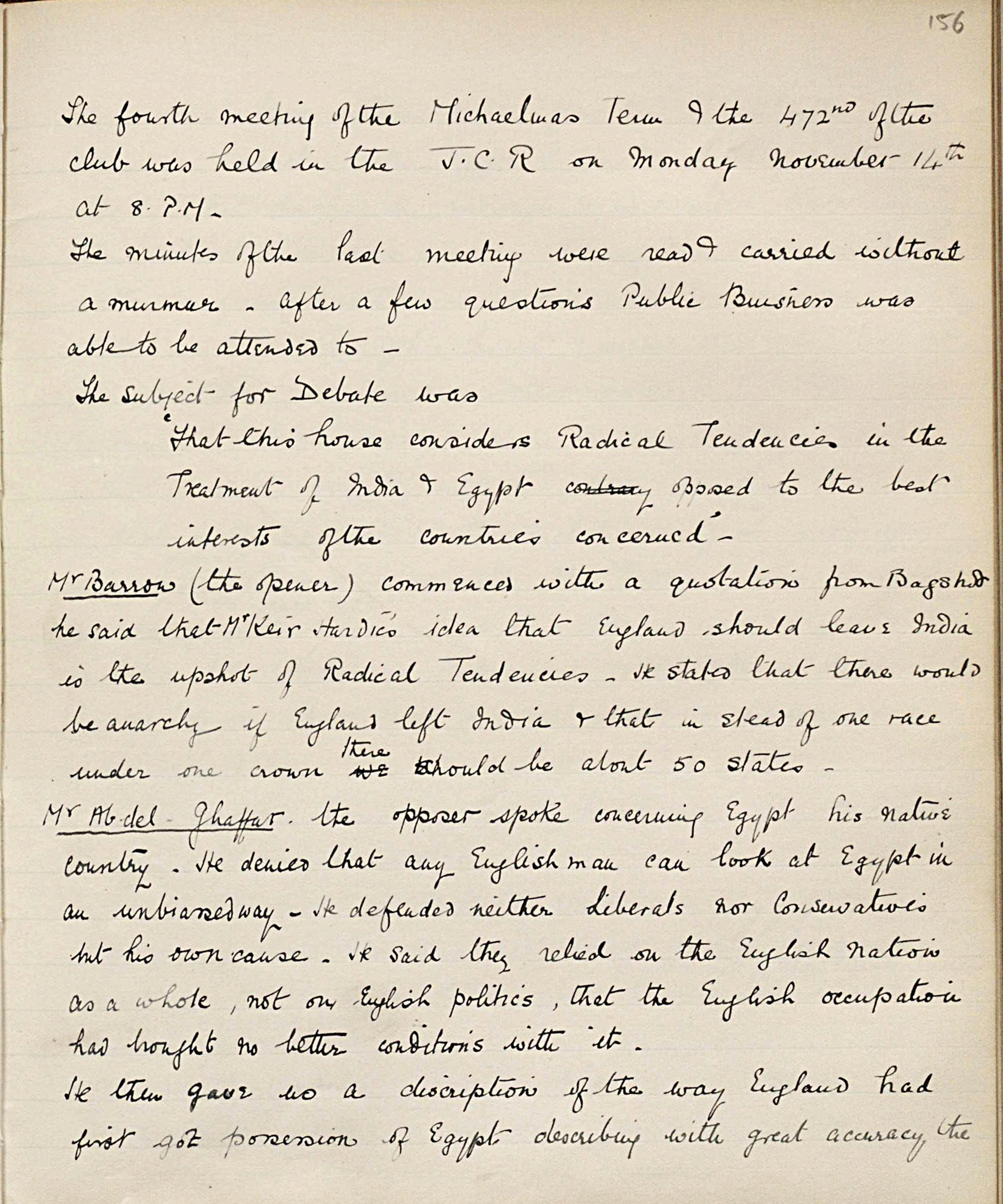
The opposer, speaking second and against the motion, was Ahmed Abdul El Gaffar, the son of an Egyptian landowner, who would return to Egypt after university, and enter politics serving as Minister for Agriculture and Public Works. Speaking third, for the motion and in support of the opener, was Haldodderi Surappa Narayana, the son of an Indian landholder, who would serve in colonial administration in India as Conservator of Forests. Recording the debate and noting the quality and convincingness of the speeches and arguments, was Guy William Lambert, also the son of an army officer, who would join the War Office as a civil servant in 1913, remaining there until 1951.
St John’s College Debating Society, Minute Books, vol. 3, 1903-1913 (folio 156r), St John’s College, Archive
For us the fascination lies in seeing the debate and its many voices from a range of perspectives through Lambert’s eyes – from across the distance of over a hundred years – and sensing through his writing something of the intellectual tension and emotion of the moment:
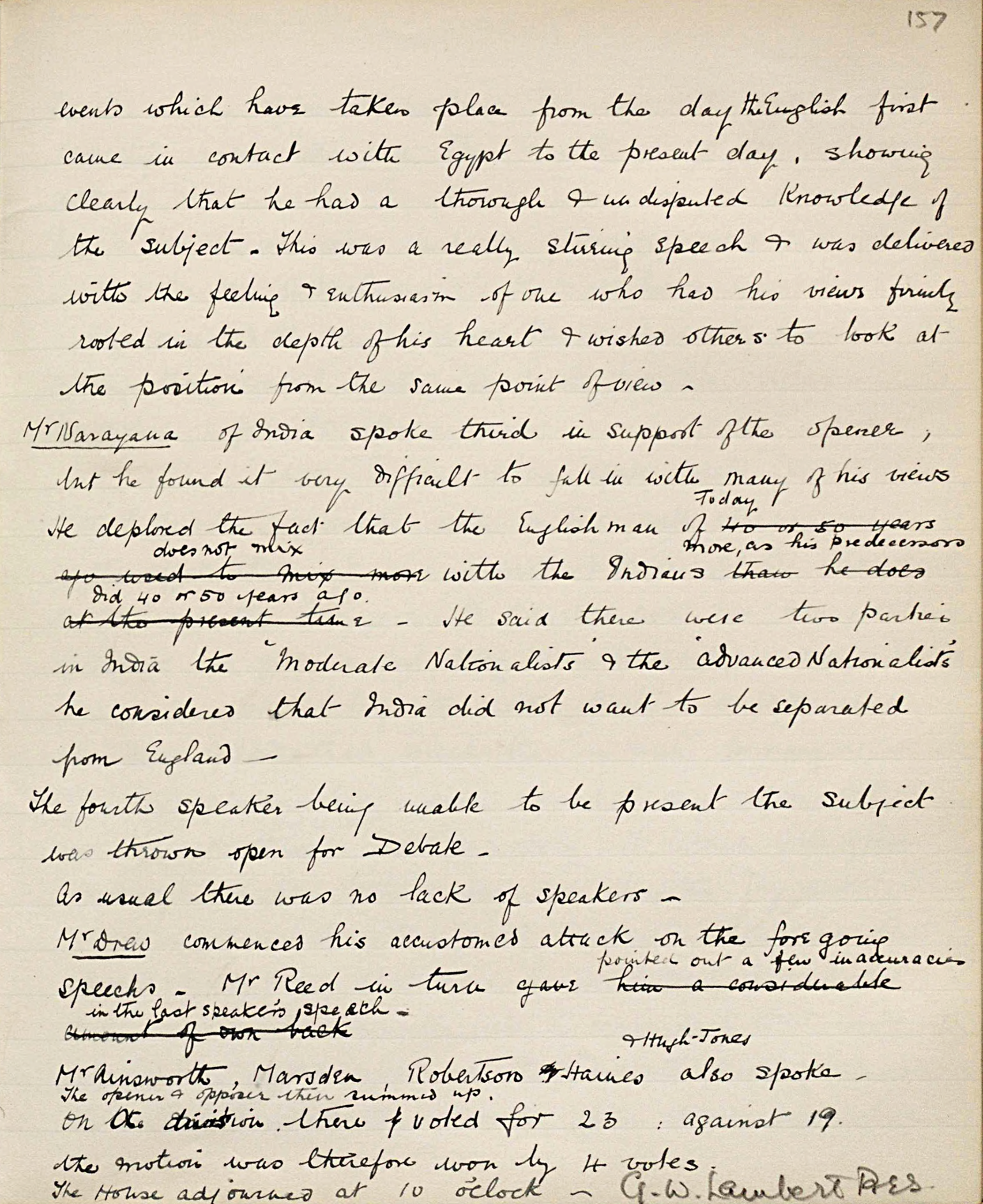
‘He [Ghaffar] gave us a description of the way England had first got possession of Egypt describing with great accuracy events which have taken place from the day the English first came in contact with Egypt to the present day, showing clearly that he had a thorough and undisputed knowledge of the subject. This was a really stirring speech and was delivered with the feeling and enthusiasm of one who has had his views firmly rooted in the depth of his heart and wished others to look at the position from the same point of view’.
St John’s College Debating Society, Minute Books, vol. 3, 1903-1913 (folio 156r), St John’s College, Archive
Edward Ainslie Gordon Sanderson
E. A. Sanderson was born in 1869 and studied at Harrison College, Bridgetown, Barbados. Harrison College is one of the country’s pre-eminent academic institutions, founded as a free public school for poor and indigent students in 1733. In 1888, Sanderson arrived at Oxford where he studied Mathematics. He matriculated the University as a non-collegiate student, but moved to St John’s in 1889.
St John’s College, Rugby Team 1891-92: Edward Ainslie Gordon Sanderson is the 1st from the left in the front row, St John’s College, Archive

Here he won two scholarships, the Stuart Exhibition and the prestigious Casberd Exhibition (‘exhibitions’ being prizes or funding usually given for excelling in an examination). He took his BA in 1901.
The records of the British Red Cross from 1919 show that an Edward Ainslie Gordon Sanderson volunteered to serve on night duty in a London hospital during the First World War.
St John’s is not a College with strong-rooted connections with the British Empire – or so it has been understood. Until recently, it was thought the earliest ‘colonial’ student at St. John’s had arrived in 1892. Yet, from what we now know, Sanderson, who was probably St John’s first black student (and very possibly the first student from Asia, Africa, or the Caribbean), pushes that date back to 1889.
Ishwardass Jaipal Singh
Jaipal Singh was an exceptional student, a teacher, and colonial administrator, an outstanding sportsman, a brilliant speaker, a determined politician, and a seminal figure in the history of Adivasi (tribal and indigenous people’s) rights in India. Born in 1903, in a small Adivasi village in Eastern India, Jaipal Singh was educated locally at the village school run by missionaries, and at St. Paul’s School, Ranchi, run by the Anglican SPG (Society for the Propagation of the Gospel), which sent him to Oxford.
St John’s College, Hockey Team 1925: Ishwardass Jaipal Singh sits in the centre of the middle row, St John’s College, Archive

Jaipal Singh matriculated in 1922. He read PPE (Philosophy, Politics, Economics), taking his BA in 1926 and his MA in 1929. He was Secretary and then President of the Debating Society, played in the College’s Football XI team, and in the College and the University’s Hockey teams, contributing to the latter’s win against Cambridge in 1924 – being awarded a Hockey blue.
In 1927-28 Singh was an Indian Civil Service Probationer but resigned, taking instead a covenanted mercantile assistantship with the Royal Dutch-Shell Group in Calcutta from 1928-32. Singh went on to work for the British Colonial Service and was made Minister for Colonialism in the Princely state of Bikaner in 1938. In 1939 Jaipal Singh became the President of the All India Adivasi Mahasabha (All India Association of Indigenous Peoples).